Description
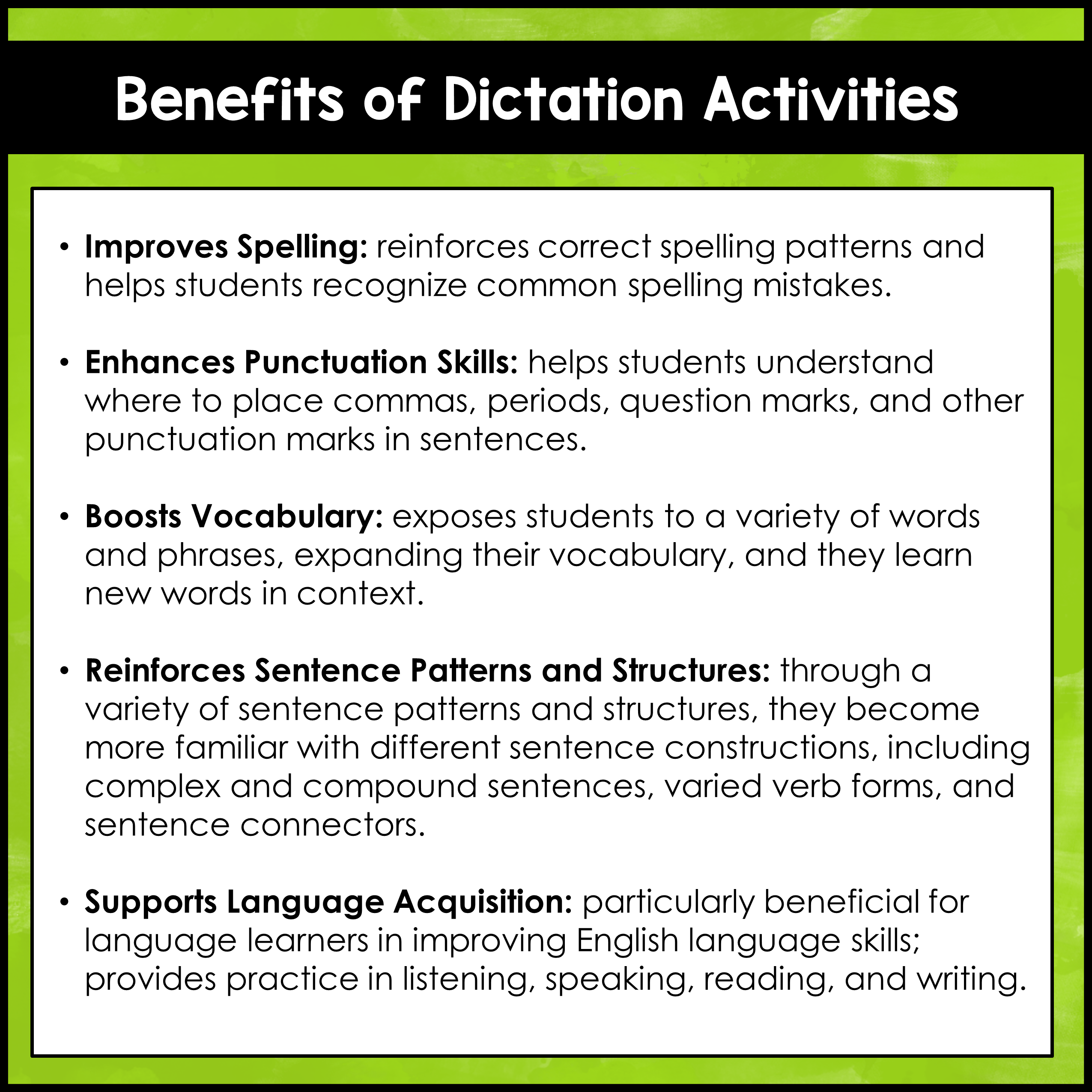
If your students need to build writing skills in several areas, such as sentence structure, spelling, punctuation, and capitalization, sentence dictation is an incredible tool to help make them better and more confident writers. Incorporate these short dictation activities into your routine, and you’ll be amazed at how quickly you can start to see a difference!
⭐️ NOTE: This resource contains short passages for dictation (2-4 short sentences). If you would prefer to start with single sentences and mainly focus on spelling, try Sentence Dictation to Build Spelling Skills.
I absolutely love a spiral review activity that can hit on multiple language points at the same time. Even better if students have an opportunity to notice and discover patterns because whatever they figure out for themselves they are sure to remember better. And for English learners, this is hands down my favorite thing to do regularly to help them become more aware of language patterns and vocabulary.
These dictation activities will give students TONS of practice with:
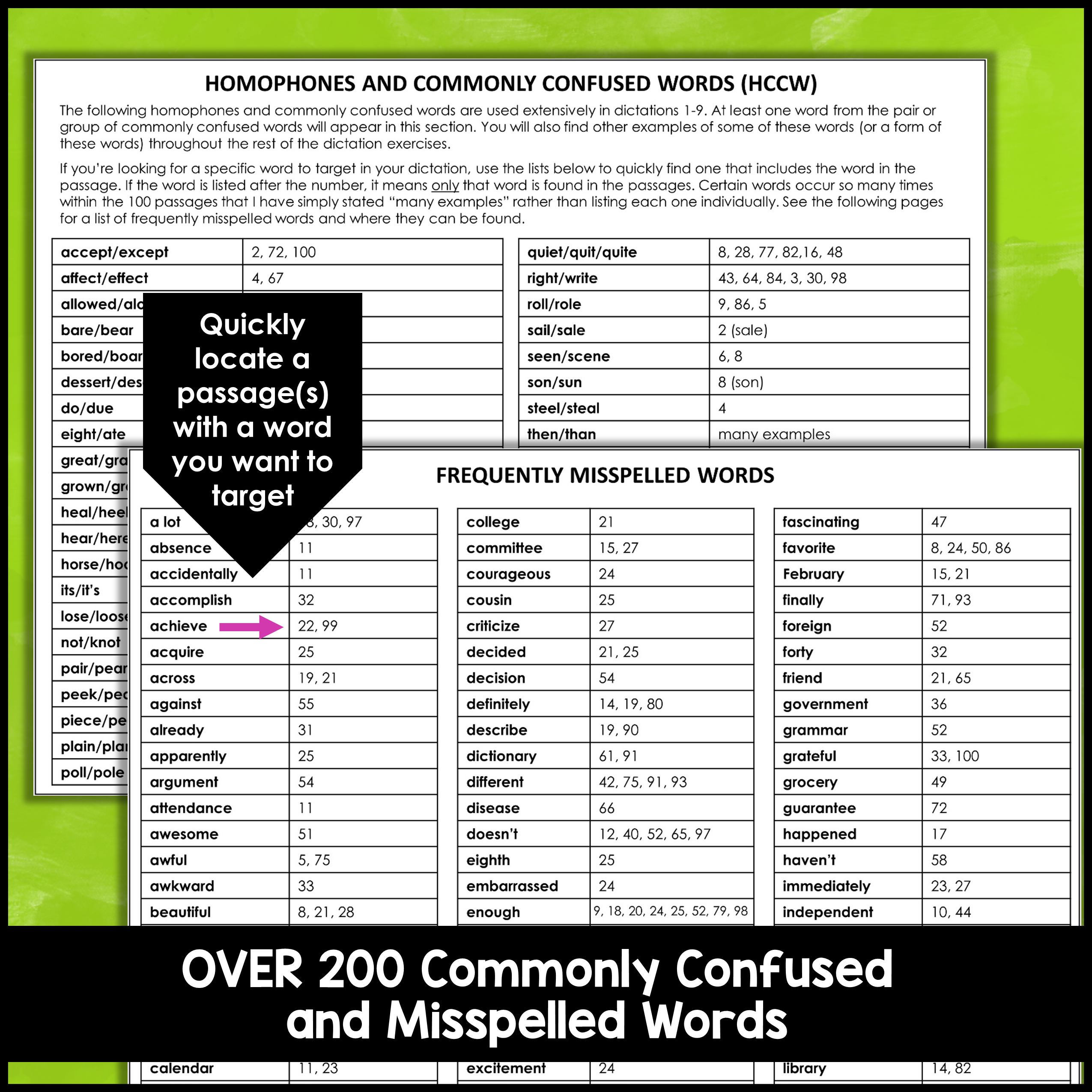
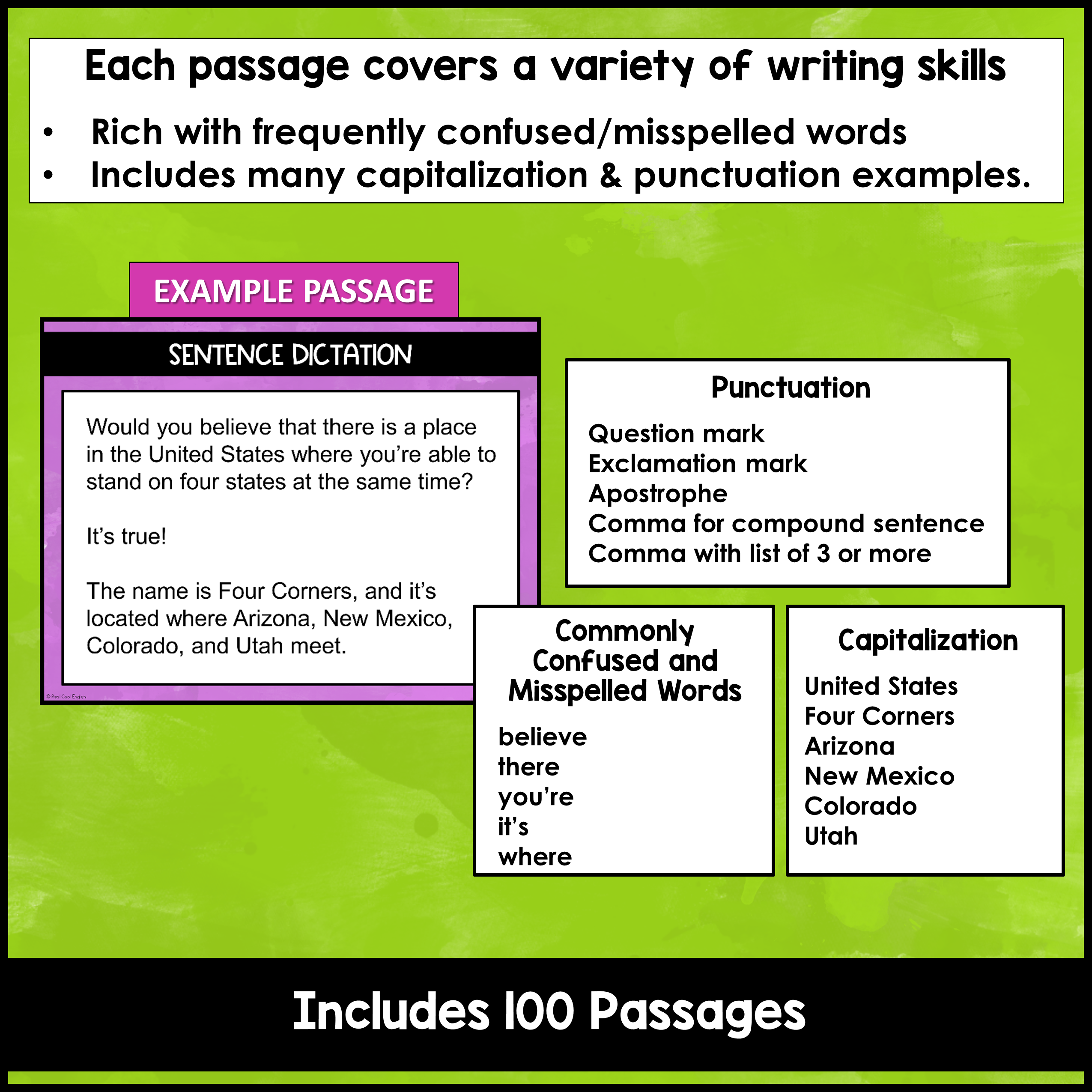
- Spelling: over 200 commonly confused and misspelled words (U.S. spelling)
- Punctuation: commas, apostrophes, quotation marks and more
- Capitalization: proper names of people, places, companies; months, days of week, etc.
- Vocabulary: new words or words they would not normally use
- Sentence structure: a variety of sentence constructions, including compound and complex sentences, verb forms, and sentence connectors
⭐️ Want to take a closer look? Click the PREVIEW link above!
Included in this packet of 100 dictation passages are:
- Wide variety of engaging topics with target words, punctuation, spelling, and sentence structures. Types of passages include:
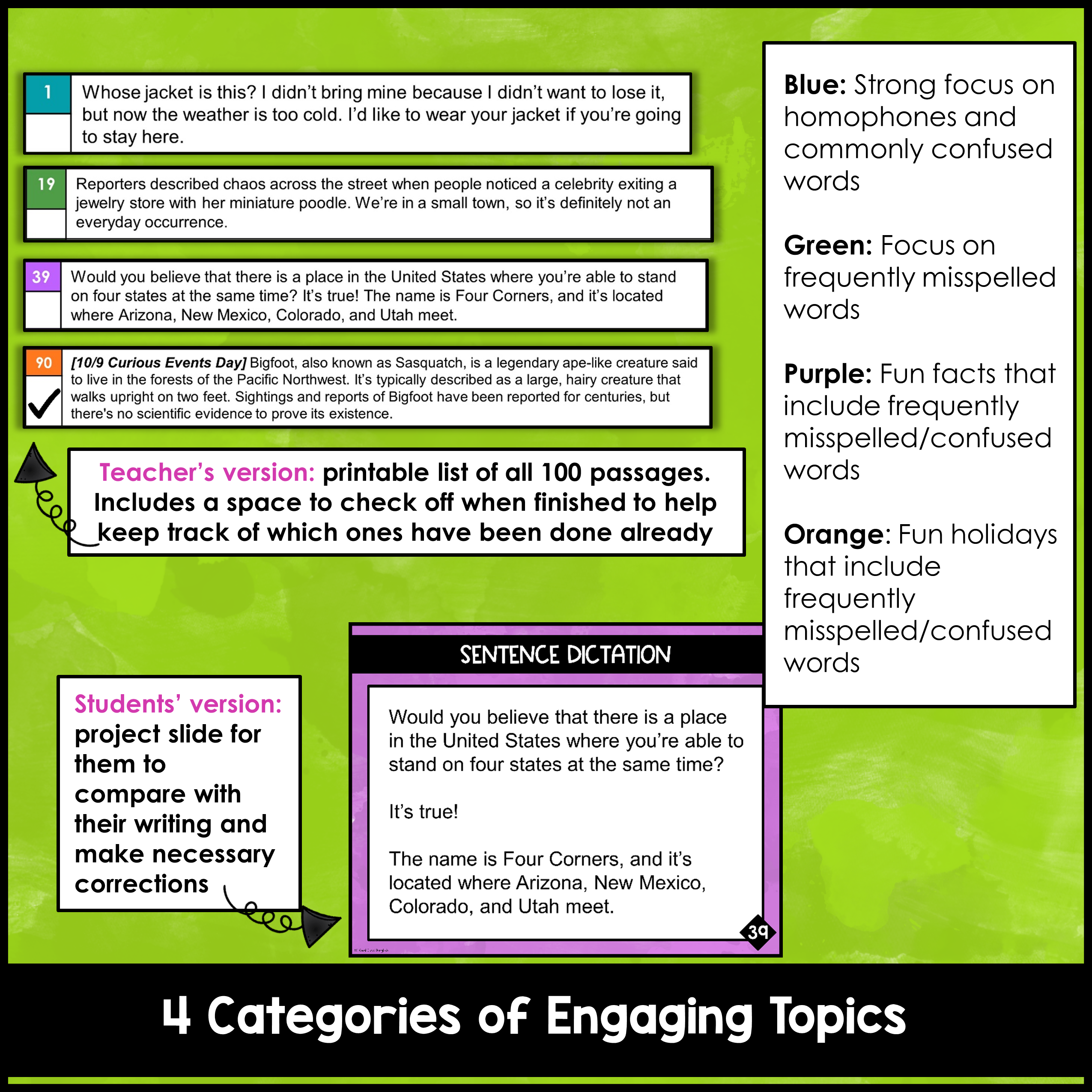
- Sentences created with a heavy focus of homophones and commonly confused words. Each passage contains a variety of words that students find tricky. (e.g. your/you’re, accept/except, lose/loose)
- Sentences created with a focus on other frequently misspelled words (e.g. definitely, February, awful, beautiful)
- Fun facts: students will find them interesting, and they have been created to include target words and a variety of punctuation and capitalization examples
- Fun holidays: similar to fun facts but can be used throughout the year to coincide with interesting unofficial holidays. Most could also be considered fun facts and don’t necessarily need to be used with reference to the holiday.
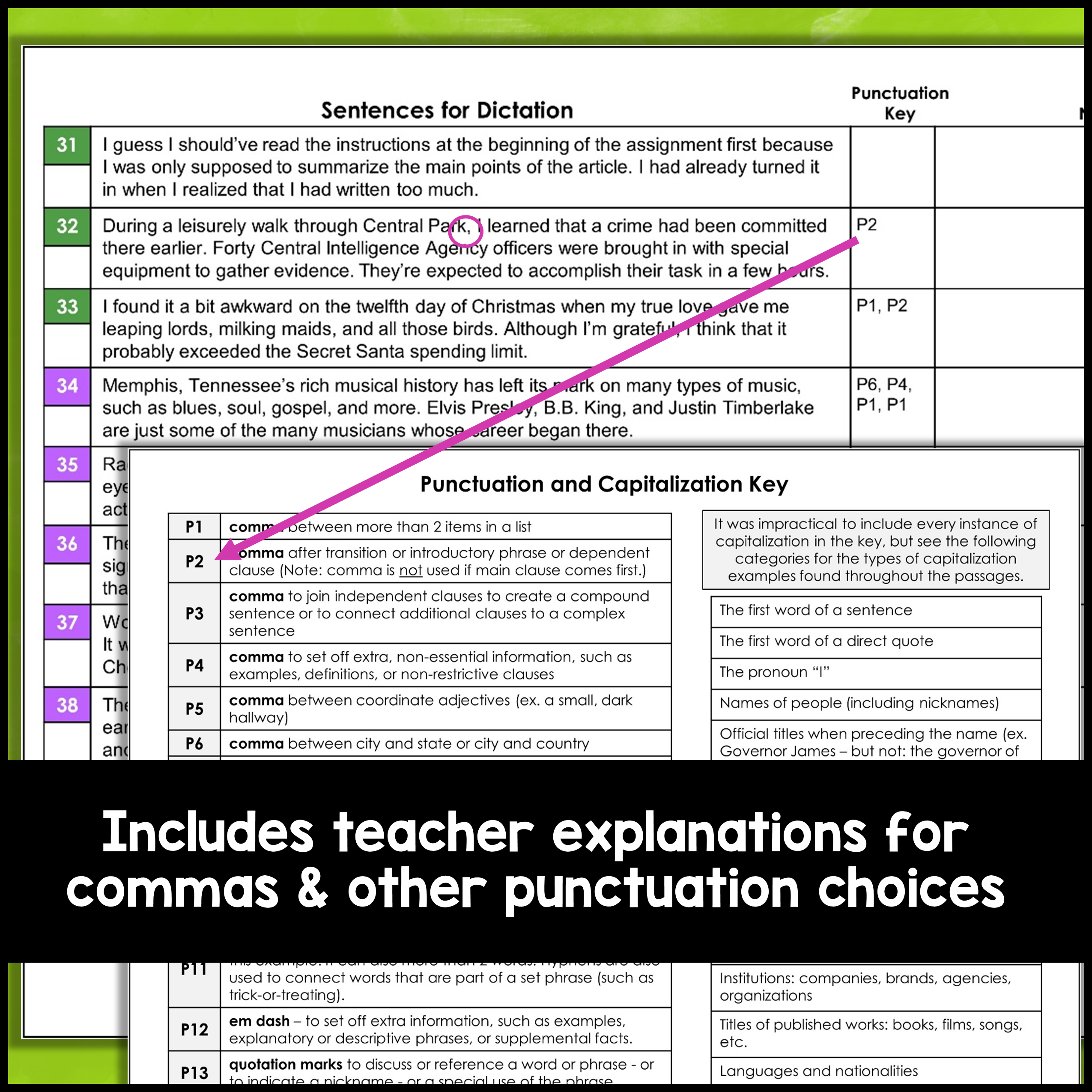
- Teacher copy of passages: a printable copy of all 100 dictation passages and a code for the different uses of punctuation in each
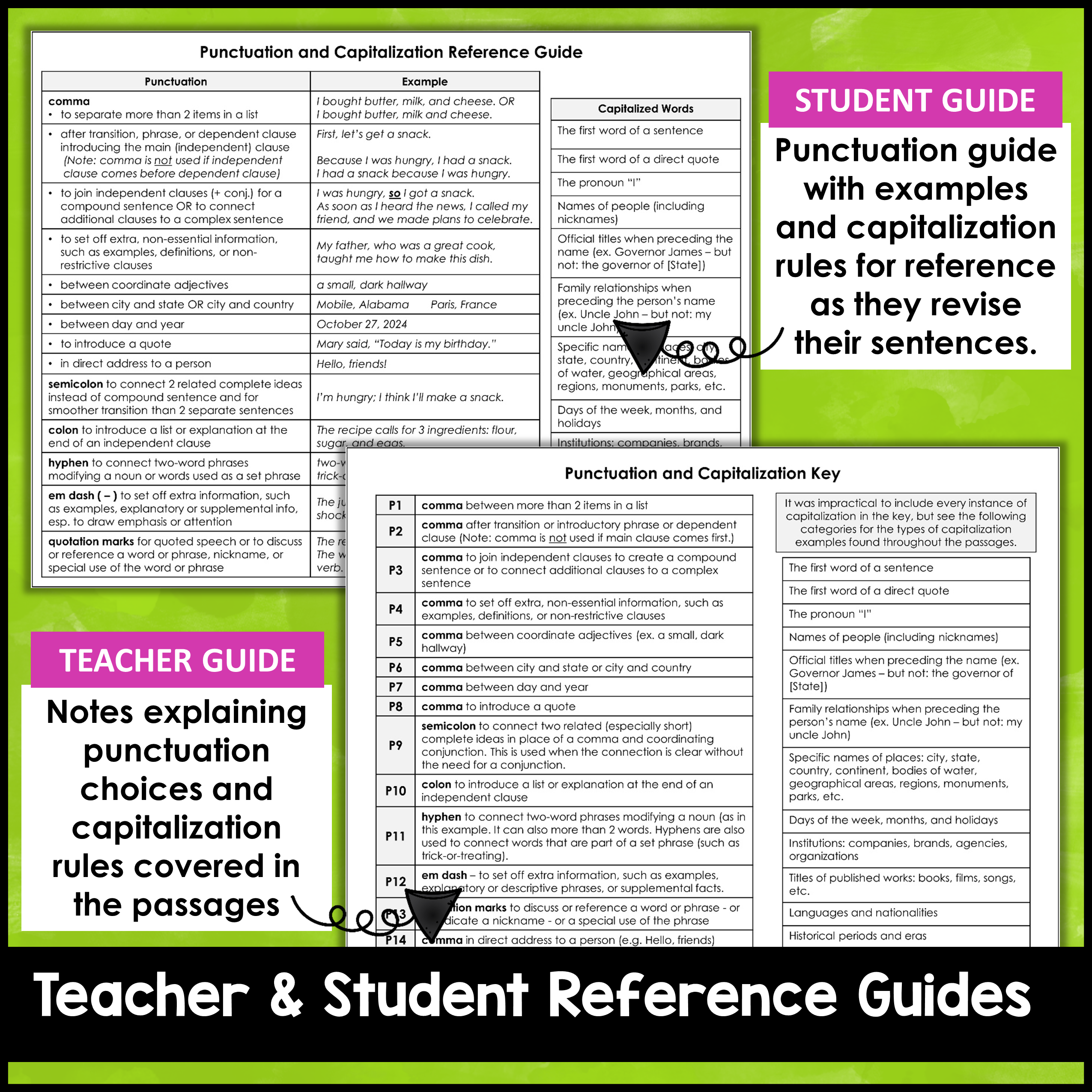
- Teacher key and and reference sheet: Includes the explanation for the punctuation codes. This is helpful in the event some clarification is needed as to why a particular type of punctuation was used. (Note that punctuation, and comma use in particular, is not an exact science, so there could be other options. I have just included one way to do it. This offers the perfect opportunity for class discussion about differences and preferences.)
- Student reference sheet: It may be helpful to make this available as they are revising their transcribed sentences as a reminder for capitalization rules and as a guide for using punctuation.
- Each passage on an individual slide: This is helpful if you wish to project it to your students for them to compare with their own transcriptions.
Dictation activities can be used for:
✅ Bell ringers
✅ Test prep
✅ Weekly spiral review
✅ Focused practice when covering a particular structure
✅ Individual or partner work (My favorite way to do this is to have students partner up to compare answers, fill in gaps, and figure out discrepancies)
Reviews
There are no reviews yet.